Crown & Continental
Artillery(Reenacted)
Explore Revolutionary War artillery through a modern living history group developing separate British Royal Artillery and American Continental artillery impressions. Our planned Royal portrayal centers on Lieutenant John Macleod’s detachment; Harrison’s regiment is our current working Continental impression.
Interested in joining us or learning more? Get in touch through our unit contact form or Facebook page.
Interested in joining?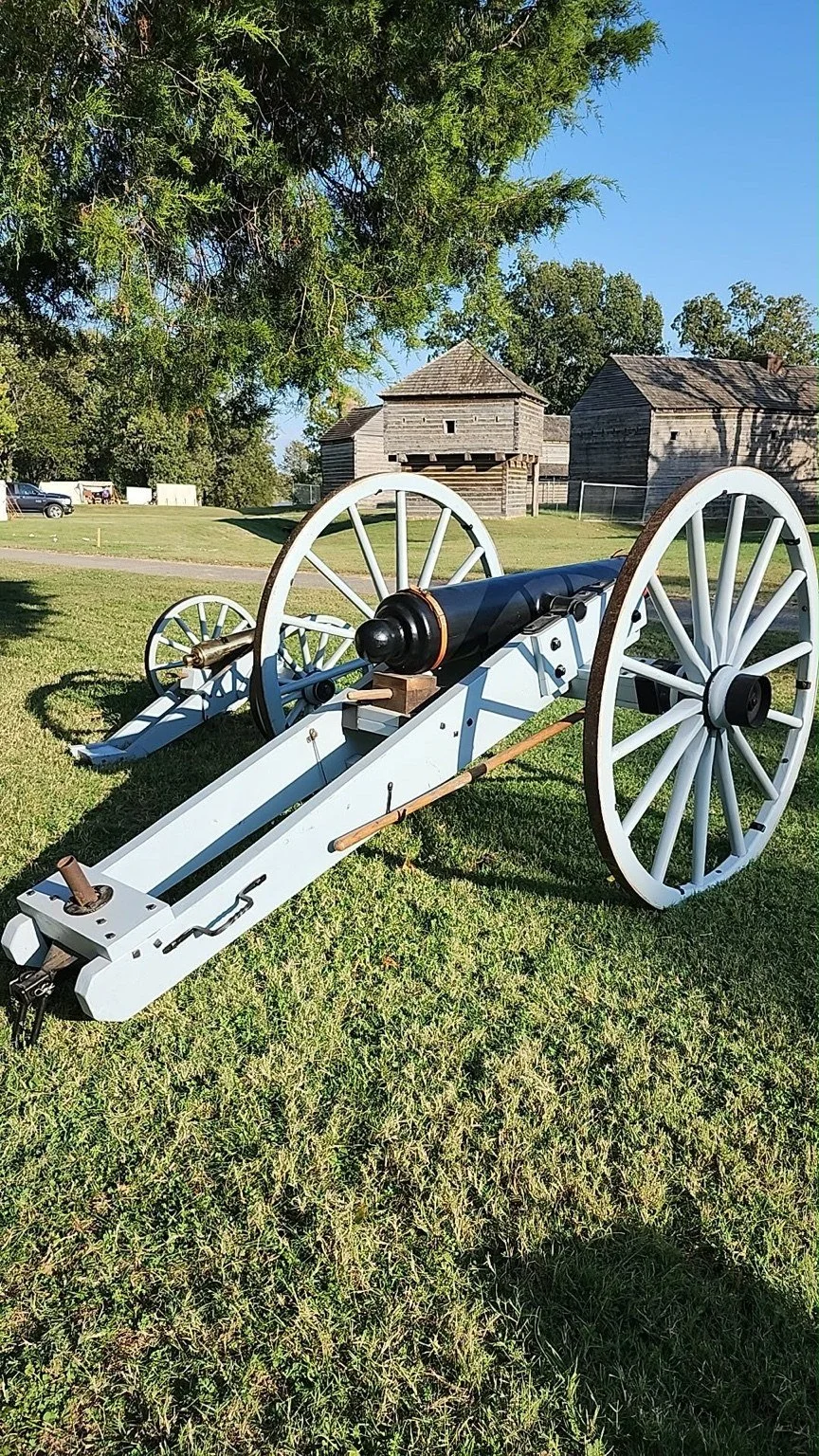
The histories behind the portrayals
Crown & Continental Artillery (Reenacted) is a modern group. The Royal Artillery and Continental artillery were separate historical organizations. Each impression follows its own evidence, and portrayals may be tailored to an event’s documented date and setting.
Royal Artillery — John Macleod
What the evidence establishes
The strongest connected story begins with John M’Leod in the August 1780 administrative paperwork of Major Peter Traille’s 3rd Battalion Royal Artillery company. In the same month, Cornwallis placed Lieutenant M’Leod with four guns on the British left at Camden. In March 1781 Cornwallis named Macleod as the officer commanding the artillery at Guilford Court House and identified two three-pounders he brought forward in the battle. These are distinct records of company administration and field command, not proof that one unchanged set of gunners served at both battles. [S01, S03–S07] This report gives the complete public account currently supportable from the project’s inspected record and documented transmissions. “Full” describes the scope of this history and its evidence register; it does not imply that every possible archival record has been found, that the complete August roster has been certified as a battle roster, or that all questions are closed.
The regiment, company, and field detachment
A Royal Artillery officer could be listed in an administrative company while serving elsewhere on command. The August 1780 muster and pay papers name Major Peter Traille’s company in the 3rd Battalion and list John M’Leod as a first lieutenant. The muster places M’Leod and Captain-Lieutenant Robert Lawson under an “on command” bracket. The pay list records their pay through the agent. None of these marks names the men attached to M’Leod in a later battle. [S03] The 1781 War Office Army List places Macleod among the first lieutenants, with regimental seniority dated 7 July 1779. The 1783 list records a promotion as captain-lieutenant and captain dated 9 January 1782. Thus “Lieutenant Macleod” is the period-appropriate battle title for Camden and Guilford. The later promotion does not change his rank retrospectively at either battle. [S01, S02]
Charleston: a carefully bounded context
Charleston fell to British forces in May 1780. A catastrophic explosion followed the surrender as captured arms were gathered. William Moultrie’s 1802 firsthand memoir describes loaded arms, a storehouse and the blast; a later regimental history reproduces part of a Royal Artillery manuscript account and a reported remark to Traille that “young Macleod” had escaped. The historical episode is clear in independent firsthand accounts, but the project has not inspected the original manuscript behind that Macleod-specific quotation. [S10, S11] For that reason this report does not assert Macleod’s exact position in the building, a wound, his actions during the blast, or an exact casualty total attributable to his detachment. The specific “escape” statement is preserved as a later printed extract of an uninspected primary letter, not promoted to a freshly collated manuscript. The later Traille company record shows an August administrative connection, not retroactive proof of Macleod’s May assignment or whereabouts. [S03, S10, S11]
Why this context matters The episode shows how an artillery establishment depended on armories, storekeepers, artisans, ammunition, and the handling of captured weapons. It also warns against treating “Royal Artillery” as only the men who fired field guns. The original 30 June 1780 Civil Branch of Ordnance muster, currently known here through a modern transcription citing the Wray Papers, names workers and casualties but its image has not been inspected by this project. No such names are assigned to Macleod’s crew in this edition. [S12]
Camden, 16 August 1780: the British guns
Cornwallis’s dispatch of 21 August 1780 gives a dated battle disposition. Lord Rawdon’s left division included two six-pounders and two three-pounders “commanded by Lieutenant M’Leod.” Two more six-pounders stood in reserve with the 71st Regiment. The six pieces in that disposition should not be collapsed into four, and the reserve pair should not automatically be assigned to Macleod’s four-gun group. [S04] The dispatch is a commander’s report written five days after the action and later printed in contemporary official form. It is strong evidence of Cornwallis’s stated deployment and Macleod’s command. It does not list the individual crews, the distribution of every artilleryman among all six guns, or each shot fired during the battle. Cornwallis’s account praises Macleod’s exertion, but praise cannot supply the missing personnel return. [S04]
Guilford Court House, 15 March 1781
Cornwallis’s report dated at Guilford on 17 March says he ordered Lieutenant Macleod to bring forward the guns and cannonade the American center. As the battle continued, artillery kept pace along the road. When American cavalry counterattacked near the courthouse, Cornwallis said that fire from two three-pounders just brought up by Macleod helped repulse it. He later identified Macleod as the artillery commander. These statements establish the British commander’s reported sequence and Macleod’s role, not the identity of every gunner. [S06] Cornwallis also reported the capture of four American six-pounders and two ammunition wagons. His description of the two British three-pounders brought to the crisis must not be confused with the American six-pounders taken and retaken in the fighting. The reported effect on the cavalry is Cornwallis’s perspective; it should not be turned into unsupported casualty figures or a claim that a single volley alone decided the battle. [S06]
Guilford: field strength and casualties
A contemporary field return for Cornwallis’s army at Guilford gives a Royal Artillery entry of three lieutenants, seven sergeants and forty rank and file, totaling fifty. The original is located by the Clements Library subject index in the Henry Clinton Papers, volume 149, folio 32. The project currently relies on a National Park Service reproduction from a photostat of that original for the numbers; it has not collated the manuscript itself. Accordingly, the fifty is a reproduced return figure, not an independently reread original in this edition. [S07] The corresponding casualty material is located in volume 149, folios 30–31. Its reproduced Royal Artillery entry gives one lieutenant and one ranker killed and four rankers wounded; the attached officer list names Lieutenant O’Hara as the dead officer. The names of the killed ranker and the four wounded rankers are not supplied in the checked return. The third lieutenant also remains unidentified. [S07, S08]
Equipment, uniforms, and daily work
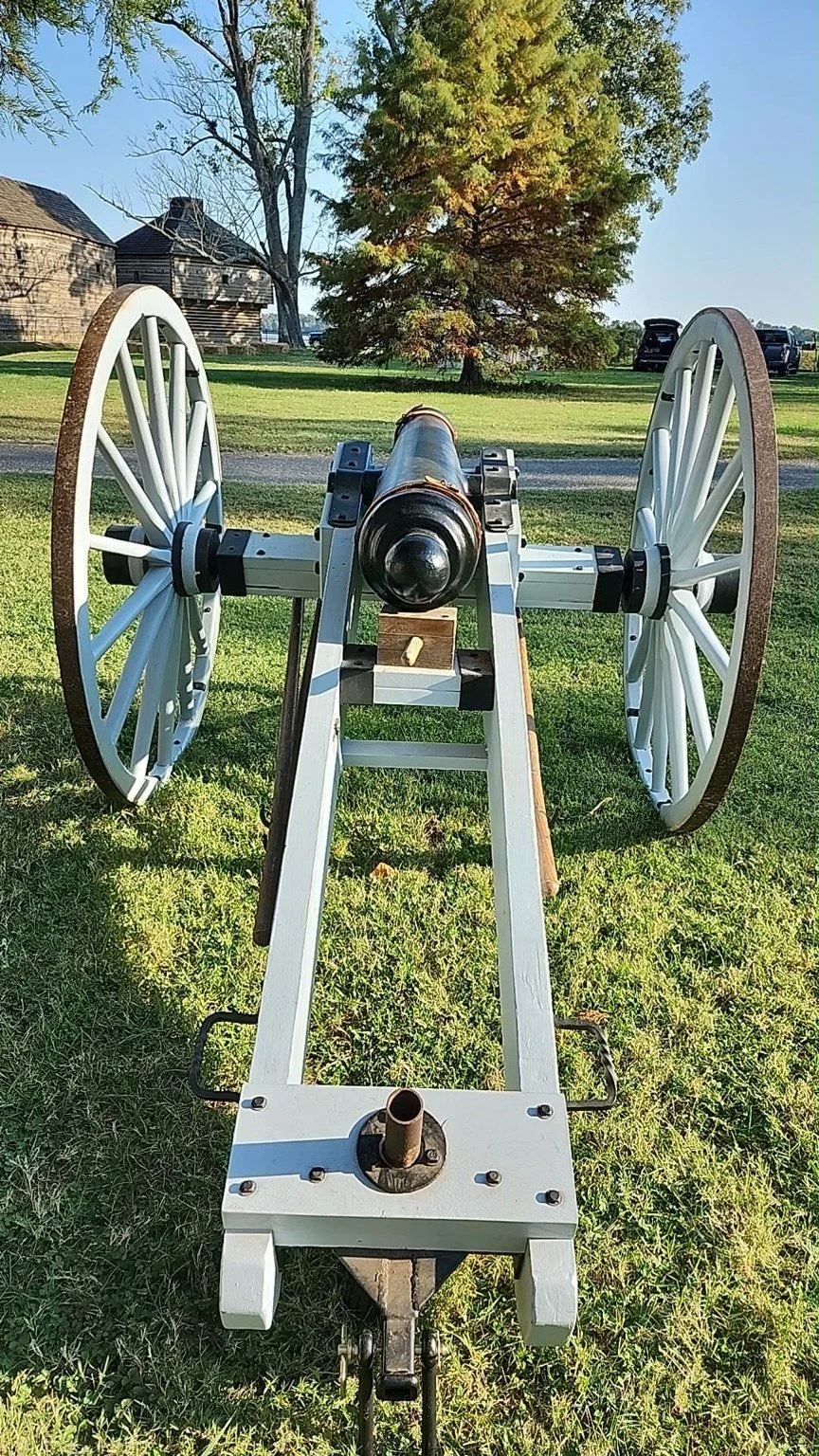
The accepted primary evidence identifies three- and six-pounder field pieces in the Camden and Guilford accounts, and it identifies ammunition wagons, travelling carriages, limbers and fixed ammunition in captured-stores returns. Those are documented categories. The records checked for this report do not identify the maker, year of casting, bore markings, carriage details or ownership of the modern group’s cannon. A modern photograph cannot establish that it is the actual gun used in either battle. [S04–S06, S13] The August Traille paperwork contains ranks such as bombardier, gunner and matross, but a rank label alone does not specify an individual’s exact duties during Guilford. Officer testimony from Springfield illustrates how hauling a gun, preserving its limber and managing ammunition could matter in the field. It is evidence about O’Hara’s separate documented action, not a diary of Macleod’s Guilford crew. [S03, S09] The project has not verified named, dated issue or receipt records sufficient to reconstruct the exact garments worn by Macleod and every gunner at Camden or Guilford. Army-wide regulations, museum objects and general descriptions can inform interpretation, but they cannot substitute for proof of a particular man’s campaign clothing. The public presentation should therefore identify any reproduced uniform or equipment as an interpretation and avoid asserting one universal appearance for the whole detachment. [S14]
Reenactment interpretation labels • “Royal Artillery portrayal” identifies the modern program. • “Macleod’s documented command at Guilford” identifies a historical event with a named commander. • “Equipment based on period sources” identifies a reconstruction, not an original battle relic. • “Crew identity under research” states the current limit honestly.
After Guilford and the 1782 promotion
The 1783 War Office Army List gives Macleod a captain-lieutenant and captain promotion date of 9 January 1782. This provides a secure later rank marker, but a rank list alone does not trace every posting, action or subordinate between March 1781 and the end of the war. The report therefore does not invent a continuous service itinerary or assign him to events solely because the Royal Artillery served in a wider theater. [S02] One alleged Macleod letter to Congreve dated 21 April 1781 has a disputed Royal Artillery archive locator. The project has not inspected the manuscript and does not use a later paraphrase to fill that gap. Other catalogued correspondence can guide future work after an exact source item and image have been verified. [S14]
The modern portrayal
Crown & Continental Artillery (Reenacted) is a present-day group, not an eighteenth-century combined British and American unit. John Macleod’s detachment is the Royal Artillery impression the group plans to portray. The historically documented Camden and Guilford episodes provide specific settings for that portrayal. They do not require the group to claim that its present members, cannon or equipment were physically at either original battle. The group may tailor a Royal Artillery impression to the date and context of an event. In each case, the event description should say which officer, artillery organization or broader role is being interpreted. If the event concerns a battle where Macleod’s presence has not been established, the presentation should not borrow his Camden or Guilford service as a claim of attendance. British Royal Artillery and American Continental artillery remain separate historical narratives. A reenactment video description should explain the original event, the specific modern portrayal, and whether the historical unit represented is documented at that battle. Other educational videos can have individual descriptions about guns, equipment, sources or demonstrations. This page’s update statement is deliberately open-ended: as new information is found and verified in primary sources, the history and citations will be revised. No public update interval is promised.
Suggested wording beside the download Read the full Royal Artillery history (PDF). This detailed report presents the primary records behind our Macleod portrayal, explains what they establish, and identifies questions that remain open. Revised editions will be posted when substantial new evidence warrants an update.
As new information is found and verified in primary sources, we will update this history and its citations.
Download the Royal Artillery history · PDF · 23 pages
Selected narrative from the approved 29 October 2026 report. Bracketed S references lead to its source guide. The full PDF includes the detailed returns, tables, evidence limits and open questions.
Continental Artillery — Harrison’s Regiment
Authorization, November 1776
On 26 November 1776 Congress authorized an artillery regiment to be raised in Virginia on the Continental establishment, incorporating two companies already raised there. The resolution prescribed a ten-company body under a colonel, lieutenant colonel and major, with officers, sergeants, bombardiers, gunners, corporals and matrosses in each company. It also prescribed muskets and bayonets in place of fusees. This was an authorized establishment, not a field return of men already enlisted or guns already issued. [C01] Four days later, on 30 November, Congress elected Charles Harrison colonel, Edward Carrington lieutenant colonel and Christien Holmer major, along with captains, and sought Virginia recommendations for subalterns. The election connects Harrison to the newly authorized body. The captain list does not settle later succession or prove that all ten companies reached establishment strength. [C01] Date
Changing organization and Maryland artillery
The developing Continental artillery organization included Maryland companies as well as the Virginia-raised body. A Maryland Assembly resolution of 9 May 1780 named Brown’s, Dorsey’s and the late Gale’s companies and directed that they be incorporated with Harrison’s regiment or another Continental regiment, with a proposed four-company arrangement under Maryland officers. The “or” matters: the authorization itself was conditional, not an immediate roster of Harrison’s battle companies. [C04] A congressional committee report of 7 January 1782 says Maryland artillery companies had been incorporated with Harrison’s regiment and criticizes aspects of the officer arrangement. It is evidence that incorporation had occurred in some form by the report, but it does not date each transfer, identify all enlisted men, or place those companies at Guilford or Eutaw in 1781. A separate 18 April 1780 letter described an arrangement as conditional. Proposal, authorization and actual implementation remain distinct. [C04]
Camden, 16 August 1780
Otho Holland Williams’s participant narrative of the 1780 campaign describes Captain Singleton commanding artillery at Camden and opening his battery when Williams ordered him to do so. The narrative is a later printing of a firsthand account, not a manuscript freshly collated in this edition. The battle paragraph names “Captain Singleton”; a later portion of the narrative identifies Anthony Singleton in a reorganized artillery context. The source supports a Singleton field command at Camden while the precise full personnel list remains open. [C07] A British contemporary return dated 29 August covers the combined actions of 16 and 18 August. It lists an artillery lieutenant/adjutant Coleman killed, Captain Meredith missing and Wallace a prisoner. The return does not, by itself, give all forenames or allocate every entry to exactly one of the two actions. Later firsthand accounts by Meredith and Wallace can help but must not erase the return’s broader reporting scope. [C08]
What cannot be inferred after the defeat • Singleton’s named gun crew cannot be moved intact into the later Guilford fight without a dated personnel bridge. • A captured or missing artillerist cannot be counted in a later field company without release, exchange, replacement or return evidence. • A later Coleman surname is not automatically the same person as the killed lieutenant/adjutant.
Singleton at Guilford Court House, March 1781
Thomas Jefferson wrote the president of Congress on 21 March 1781 that Captain Singleton, an officer of Harrison’s artillery, had recently arrived in Richmond and had been in the action at Guilford Court House on 15 March. Jefferson explicitly warned that Singleton left camp the following day and was not reporting from particular completed returns. The letter is strong contemporary evidence for Singleton’s personal battle attendance and Harrison affiliation, not a count of his crew. [C09] Nathanael Greene’s general orders of 16 March praised the artillery served by Captains Singleton and Finley. This is a separate contemporary statement naming officers in the action. It does not supply Finley’s full name or settle the exact administrative company, subalterns and rank-and-file under either officer. The 13 March Southern Army return lacks a separate artillery category; a 31 March infantry return says artillery and cavalry returns were not ready because those corps were on command. Neither document proves zero artillery or provides Guilford manpower. [C10, C11] Source
Hobkirk’s Hill and Ninety Six
Guilford Dudley’s sworn pension declaration of 12 October 1832 recalls artillery led by Colonel Harrison on the morning of the Hobkirk’s Hill action of 25 April 1781 and describes guns firing canister. This is later firsthand recollection rather than an action-day field return. The accessible text used in the research is a modern transcription of the pension statement; its original images remain to be collated. It supports a qualified Harrison-led action, not a named Singleton company at Hobkirk. [C13] A participant journal of Robert Kirkwood provides a separate Harrison-related artillery anchor at Ninety Six in June 1781. The specific checked passage and its date must be kept with that claim; it does not identify every company that served the siege. The report does not transfer Gaines, Brown or Singleton personnel to Ninety Six from their other appearances. [C14]
A dated Southern Army artillery return
The clearest aggregate Southern strength document presently inspected is the original Return of the Artillery Commanded by Colonel Harrison—Serving in the Southern Army, signed by Otho H. Williams at Camp High Hills of Santee on 26 July 1781. The Library of Congress item has been checked from its manuscript image. Adding its filled rank cells gives 95 fit for duty and 133 in the total column. The manuscript does not print those two sums in one grand-total cell; they are checked modern arithmetic. [C15] Rank group
Eutaw Springs, 8 September 1781
Nathanael Greene’s dispatch to the president of Congress, dated 11 September, assigns two three-pounders under Captain-Lieutenant Gaines to the front line and two six-pounders under Captain Browne to the second line at Eutaw Springs. It praises Gaines’s service. This is a commander’s contemporary report transmitted in later printings, including a period newspaper and a documentary edition. The same dispatch in several carriers remains one witness. [C12] The passage names officers and gun sections, not a numbered regiment or complete company roster. Earlier administrative records associate Gaines with particular men in 1780, and later firsthand accounts connect Brown’s Maryland company to Harrison. Neither automatically identifies every Eutaw artilleryman or proves a single unchanged company from the older payroll. The 1782 Maryland report of incorporation is later than Eutaw and cannot, alone, backdate each person’s assignment. [C04, C06, C12, C16] At Eutaw
Yorktown and late-war service
William Madison’s sworn 1836 declaration, preserved as a certified court copy, recalls an artillery appointment in Harrison’s regiment at Yorktown, service in Captain Coleman’s company, and participation through the siege and surrender. It is an individual retrospective account, with an approximate appointment date and health-related furlough. It supports a qualified personal Harrison-linked Yorktown connection, not whole-regiment attendance or an identical crew from Eutaw. [C22] A 1782 administrative muster candidate for Booker’s detachment at Camp near Bacon Bridge appears in a later compiled service-card abstract. The original M246 muster has not been collated through that card’s citation, and the same-person Morgan connection is unsettled. The report does not turn the card into proof of presence, arrival, effectives, or a Gaines/Eutaw bridge. Additional 1782 Southern records mention other Finley candidates without identifying them as the artillery officer. [C20, C23]
What a through-1783 history can honestly do It can show continuing regimental administration and named personal testimony where supported, record 1782 and 1783 findings as they are verified, and leave unproved company itineraries open. It cannot manufacture a continuous roster from formation to peace. The broader 1779–1783 research scope also cannot be added to the narrower 1779–1781 battle-count comparison as if both questions had the same denominator. [C20, C22, C23]
Clothing, equipment and the work of a gun crew
Congress’s founding establishment specifies categories of personnel and prescribed small arms. Maryland Council records later authorize linen, uniforms, cash allowances and garment deliveries to named recipients. An order to make or deliver clothing is not a signed receipt by every soldier, nor proof that a particular garment was worn at Guilford, Eutaw or Yorktown. A modern artillery uniform may be informed by such sources but should be described as a reconstruction rather than the verified dress of every man in one battle. [C01, C24] The July 1781 Southern return distinguishes sergeants, corporals, bombardiers, gunners, drummers, fifers and matrosses. Those categories show the organization’s breadth; they do not assign each named person to a particular piece. Greene’s Eutaw dispatch identifies gun calibers and commander for two sections. No checked receipt links the group’s modern cannon to an original gun in those sections, and a photograph cannot establish eighteenth-century provenance. [C12, C15]
Modern portrayal, clearly separated
Crown & Continental Artillery (Reenacted) is a present-day group, not a historical combined British-American artillery unit. Harrison’s regiment is the Continental impression the group is currently developing. The particular officer, company or artillery role shown at an event can be tailored to that event’s documented date and setting. A Camden portrayal can use Singleton’s documented command; an Eutaw presentation can explain Greene’s separately named sections without falsely claiming an intact Singleton crew there. The British Royal Artillery portrayal has its own historical section and full PDF. A modern group may interpret opposite sides at different events, but the two historical organizations remain separate. Neither the modern cannon nor today’s participants are claimed as surviving battle participants or equipment. If a particular historical unit’s attendance is not established, the event and video description should state the modern interpretation and the uncertainty plainly. As new information is found and verified in primary sources, the relevant history and citations will be updated. A revised dated full PDF will follow when a substantive change warrants it. No fixed public update schedule is promised.
Download wording for the future page Read the full Continental artillery history (PDF). This report presents the primary records behind our developing Harrison impression, the officers and gun sections they identify, and the questions still under investigation.
As new information is found and verified in primary sources, we will update this history and its citations.
Download the Continental Artillery history · PDF · 27 pages
Selected narrative from the approved 29 October 2026 report. Bracketed C references lead to its source guide. The full PDF includes the detailed returns, tables, evidence limits and open questions.
Cannon gallery
Interested in Joining?
Download joining information · PDF · 1 page
Clothing and equipment standards
Inquire within.
Everyone is welcome to express an interest, including those with no reenacting experience. Civilian portrayals and roles that don’t involve handling weapons are welcome, too.
Your first event
Contact us first, and we’ll invite you to attend an event as a spectator. Your first event is a chance to meet the members, see what we do, and ask questions before taking part.
Membership dues
There are no membership dues.
Before you buy
Contact us before purchasing clothing or equipment. We’ll help you choose items suited to the unit’s portrayal.
Loaner clothing and equipment
A limited selection of loaner clothing and equipment may be available. Please ask when you contact us so we can confirm what’s on hand.
Younger members
Minors are welcome to join. A parent or guardian must be present whenever they participate in unit activities.
Get in touch
Email CrownContinental@yahoo.com, use our unit contact form, or message our Facebook page to arrange your first visit.
Contact Crown & Continental
Questions about joining, appearances or the unit?
Email the unitFollow us on Facebook